

Let's Get Sh*t Done.
Every finding gets a named owner and a date — not a shared list that quietly becomes nobody's job. That's how a signed roadmap turns into results instead of a slide deck that sits in someone's inbox.


Focused projects
 Featured work · HaumillerSee what this looks like in practice.Read the case study Explore all solutions →
Industries we serve
Customer storyHaumiller EngineeringRead case study Ongoing partnership
 Marketing Team ProgramAn ongoing marketing team that owns strategy and delivery, with the capabilities and priorities scoped around your business.
Focused projects
 Website Design & DevelopmentSales-led messaging, design, and development for a website that helps buyers understand why to choose you.
 Revenue Systems & AI AutomationCRM improvements, inquiry routing, and follow-up automation built around how your team sells.
 Photo & Video ProductionOnsite photography and video, planned and edited for the channels that need them. Book a focused project or an ongoing production rhythm.Explore all solutions →

Watch the 30-second highlight reel (MP4) · Preview image
Client: LSC Demolition, a Chicago commercial interior demolition contractor.
Scope: Custom bid CRM, spreadsheet migration, internal follow-up automation, reporting and team onboarding.
Delivery: About two weeks from first commit to team adoption.
LSC bids on demolition scopes for general contractors. Its shared spreadsheet tracked jobs, prices, due dates and notes, but follow-up depended on someone remembering to make the call. Leadership needed a consistent view of the pipeline and a clearer explanation of why bids were won or lost.
A standard sales funnel did not reflect that process: LSC's customer might still be competing to win the underlying project. We built the CRM around how the estimating team actually works.
The original project snapshot recorded a $2.5M open pipeline, weighted to $658K using bid probabilities. These describe the opportunities being tracked at that point, not revenue generated by the CRM or a current pipeline balance.
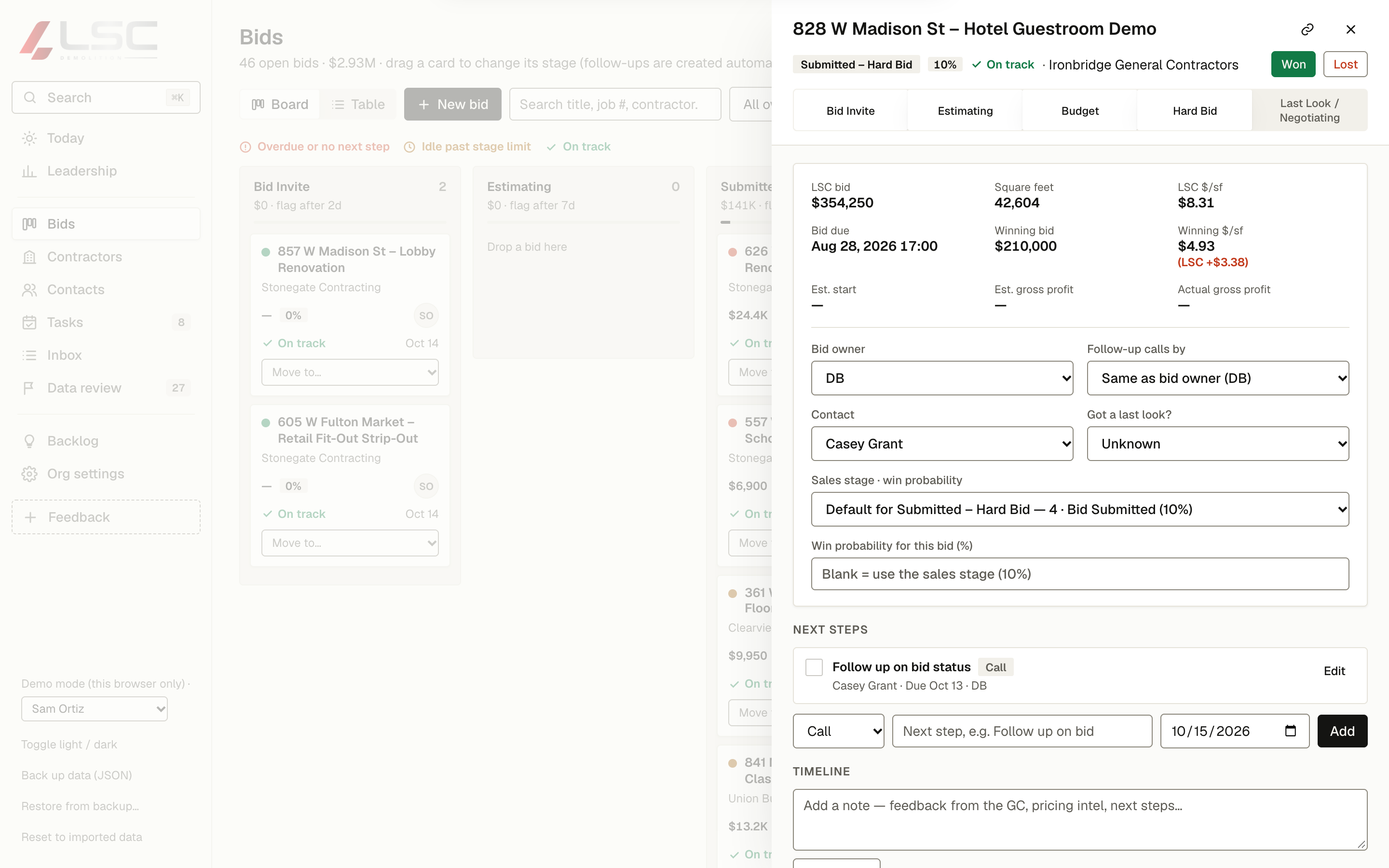
A board follows bids from invitation through estimating, submission and last look. A table provides the detailed view, including won and lost bids. Owners, due dates and aging signals help the team see what needs attention.
Moving a bid creates the appropriate internal task: a bid/no-bid decision, a follow-up call or a same-day last-look call. Logging a call keeps the next step moving. These automations prompt LSC's team; they do not automatically email contractors.
Leadership can review weighted pipeline, stale bids, loss reasons and contractor relationships together. A consistent win-rate definition keeps reports aligned, while a data-review queue highlights missing owners and incomplete loss reasons.
The Today page brings together overdue work, today's tasks and upcoming bids. Mobile layouts let estimators update records from a job site without needing the desktop board.
Role-filtered guides, a guided new-bid workflow and contextual feedback support onboarding after the initial introduction. Feedback retains the relevant page and record so improvements can be traced back to the work.
Five views of the workflow, rather than a screen-by-screen product tour. Select an image to inspect it full size.
Screenshots and video use anonymized, fictional demo data. Names and figures shown are not client records and may differ from the project snapshot above.



An optional, read-only Google Workspace connection uses Gemini to identify bid invitations and contractor conversations for a review inbox. Each team member opts in, and the team decides what becomes a bid.
The system uses Supabase for data and access controls, Vercel for delivery, and a lightweight HTML, CSS and JavaScript interface. The detailed implementation and training materials remain available separately; the public story focuses on the workflow they support.
The CRM is a separate engagement from LSC's brand and website work. Explore the LSC Demolition brand and website case study.
Working around a spreadsheet that has outgrown your process? Explore Revenue Systems & AI Automation or talk with Square Waves about your workflow.
Bids and follow-ups lived in a shared spreadsheet. Leadership needed reliable pipeline, win-rate, loss-reason, and general-contractor relationship reporting.

Square Waves imported the existing spreadsheet, refined the workflow with the team, and shipped the CRM in about two weeks. A repeatable merge preserved tasks and notes while incorporating spreadsheet updates.
Square Waves built a bid CRM around demolition estimating: board and table views, automatic internal follow-up tasks, a Today page, leadership reporting, data review, optional read-only Gmail and Calendar integration, and mobile layouts in light and dark mode.
Built-in, role-filtered Guides provide screenshot-led instructions for estimators, callers, leadership and admins. Guided workflows, contextual feedback and mobile access support onboarding and ongoing learning.
113 bids brought into one CRM, with ownership, internal follow-up tasks and shared leadership reporting. The original project snapshot tracked a $2.5M open pipeline, weighted to $658K by bid probabilities; this is opportunity value, not revenue generated by the CRM.
Plain HTML, CSS, and JavaScript; Supabase Postgres, authentication, row-level security, and edge functions; Vercel; Google Workspace and Gemini. The delivery included 54 commits, 12 database migrations, and 45 automated business-rule tests.


